
By Jason, out of care and love for the Church
This is a general reflection on trends I’ve observed from studying church history—prayerfully shared out of care for the body of Christ.
Over the past year, as I have prayerfully studied church history and listened to the hearts of ordinary believers, one truth has stood out: a growing hunger for robust biblical teaching amid concerning shifts in the church. Many are turning from shallow messages to the faithful voices of Spurgeon, Sproul, and MacArthur. Yet there is grief over ministries softening on God’s created order for manhood and womanhood under cultural pressure. Everyday Christians often discern this drift keenly, longing for churches to remain faithful ‘salt and light’ (Matthew 5:13–16).
The Timeline
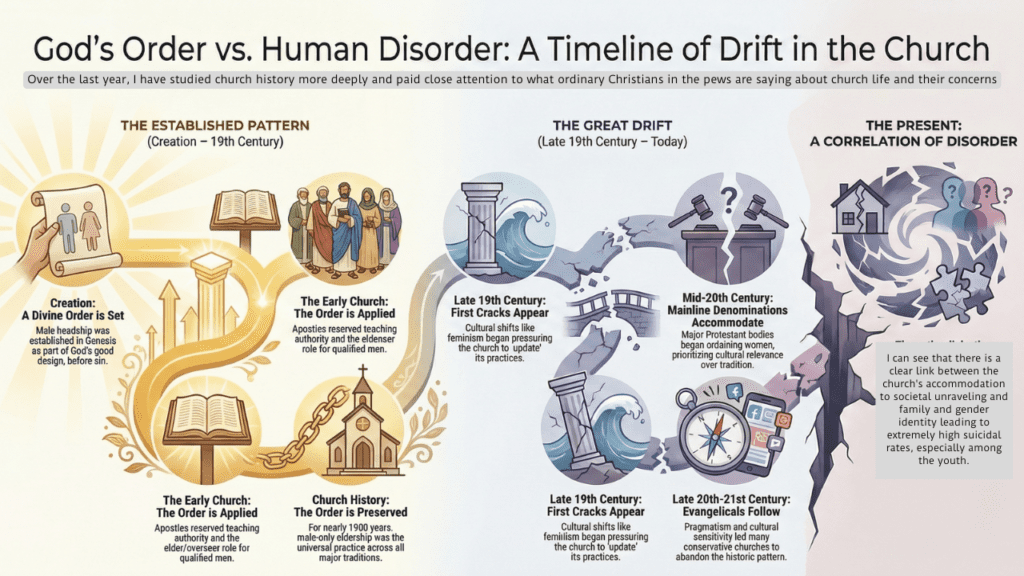
This timeline infographic captures what my studies and observations have made plain: a once-golden path of God’s established order—beginning in creation’s goodness, applied in the early church, and preserved across centuries—gradually eroded by waves of cultural pressure, leading to cracks, accommodation, and finally the fractured disorder we see today. The correlation is heartbreakingly clear: as portions of the church have yielded to pragmatism and relevance on God’s design for manhood and womanhood, society has unraveled—families fragmented, gender identity confused, loneliness epidemic, and despair claiming even the youngest lives at alarming rates.
Reflections
If the church merely reflects the world back to itself, the world may feel comfortable and say, “How pleasant—this mirrors what we already know.” But it will rarely hear the urgent call to repentance and faith: “Be reconciled to God!” (2 Corinthians 5:20). In prayerful reflection this year, one truth has grown unmistakably clear to me: over the last nearly two centuries—and accelerating rapidly in recent decades—there is a profound connection between the church’s faithfulness to God’s created order for men and women and the health of society itself.
Not Coincidence
It is no coincidence. When the church holds to order, society as a whole tends to function within the boundaries of God’s created design. When the church falls into disorder, society decays. We are called to shape culture, to set standards, and to guide direction—whether society recognises it consciously or not (often blinded spiritually to such things). The church is meant to be the light (Matthew 5:14–16). But when that light is dimmed by fear of man rather than fear of God, how can it influence the society around it? When the world’s values enter the church, the world looks in and sees only itself reflected back. Is it any wonder things are falling apart?
The Bride
That is the connection this timeline reveals. It is clear, and it is backed by history—for those willing to look, as I have taken the time to do, out of care and love for the church, Christ’s bride.
God’s Created Order → Human-Created Disorder: A Timeline of Drift
- Creation (Genesis 1–2) God forms man first, then woman as his suitable helper. Male headship is established before sin enters—grounded in the goodness of God’s design, not in fallen culture. The pattern: loving, sacrificial leadership by the man; joyful, intelligent submission by the woman—imaging the relationship between Christ and His church (Ephesians 5:22–33).
- The Fall and the Promise (Genesis 3) Sin reverses the order: Eve is deceived first, Adam fails to lead. Yet even in the curse, God preserves the structure of headship (Genesis 3:16—“he shall rule over you”). The pattern remains, now strained, awaiting redemption in Christ.
- The Early Church (Acts–Revelation) The apostles apply the creation pattern directly to church leadership: elders/overseers are qualified men—“the husband of one wife” (1 Timothy 3:2; Titus 1:6). Teaching and authority over the congregation are reserved for men (1 Timothy 2:11–14), again explicitly rooted in creation order, not local custom. The church thrives in a hostile pagan culture precisely because it refuses to conform.
- Church History (2nd–19th centuries) Across centuries and continents—East and West, Catholic and Protestant—the universal practice is male-only eldership and pastoral office. Even in times of great revival (Reformation, Great Awakenings), the church’s counter-cultural stance on gender roles remains firm. Society benefits from the stability this order brings to families and communities.
- Late 19th–Early 20th Century: First Cracks Appear Cultural shifts—industrialisation, feminism, egalitarianism—begin pressing the church to “update” its practices. Some denominations, seeking relevance, ordain women to diaconal roles, then pastoral roles. The argument shifts from “What has God commanded?” to “What works best in our time?”
- Mid-20th Century: Mainline Denominations Capitulate By the 1950s–1970s, major Protestant bodies begin ordaining women as elders and pastors. The justification: love, equality, gifts, and “there aren’t enough men.” Simultaneously, these same bodies begin softening teaching on divorce, sexuality, and the authority of Scripture. Relevance becomes the guiding principle.
- Late 20th–21st Century: Evangelical Drift Even conservative evangelical and reformed circles begin feeling the pressure. “Soft complementarianism” gives way to outright egalitarianism in many places. Churches cite pragmatism (“we need leaders”) and cultural sensitivity (“we’ll lose the next generation”). The language changes: headship becomes “partnership,” submission becomes “mutual submission,” creation order becomes “cultural.”
- Our Present Moment (2020s) Society unravels at unprecedented speed: confusion over gender and sexuality, breakdown of the family, rising loneliness and mental anguish, erosion of authority in every sphere. The church, once the moral conscience of culture, now often follows culture’s lead. Where biblical order has been abandoned, the church’s witness weakens, and society—lacking light—decays.
The correlation is unmistakable: as the church has accommodated culture on the question of gender roles in leadership, the wider culture has spiralled into deeper confusion about what it means to be male and female. The church was meant to influence the world with the beauty of God’s design (Ephesians 3:10). Instead, too often the world has influenced the church, and we all suffer the consequences. Why change God’s Word when God is all-wise and knows perfectly what works best for us?
Final Reflection
In prayerful study this year, the correlation has grown clear: when the church faithfully upholds God’s wise order for men and women—sacrificial headship and joyful submission, imaging Christ and His bride (Ephesians 5:22–33)—families flourish, and society receives stabilizing salt and light (Matthew 5:13–16). When we accommodate culture for relevance, confusion follows, and the witness dims.
The Past Is Clear
This is no new path. Israel, richly blessed with God’s revealed order, repeatedly conformed to surrounding nations—adopting their practices and abandoning distinctiveness—and reaped familial chaos, moral decay, and societal breakdown (Judges 2:11–19; Hosea 4:1–6). Scripture records these cycles for our warning (1 Corinthians 10:11), that we might not repeat them.
2026 Stand Firm
May we, by grace, return afresh to Scripture’s unchanging pattern—not as burden, but as freedom and beauty. In honoring God’s design, we honor Him who made us male and female in His image (Genesis 1:27), and we display the gospel’s power to a watching world. Let 2026 be a year of renewed fidelity, for the glory of Christ and the good of His church.
Why does it repeat?
Without watchful clinging to God’s Word, even the redeemed drift (Hebrews 2:1). Yet praise our good Father—He disciplines those He loves (Hebrews 12:6), and in mercy calls us back through repentance to restoration (Joel 2:12–13; James 4:8–10).
May the Lord God indeed bless us richly with His grace and peace, guarding our hearts in Christ Jesus.
𝓙𝓪𝓼𝓸𝓷 𝓓𝓪𝓵𝔂 2025
